


NORTH CAROLINA · UPDATED OCTOBER 2026

What North Carolina funeral professionals need to know.

North Carolina’s chain-of-custody requirements, the 2025 and 2026 changes to the funeral service law, and a free guide and checklist, cited to the statute and rule.

Informational only — not legal advice.

A funeral professional holding a phone with the MorTrack dispatch app, in front of a North Carolina skyline and state silhouette
Status
Full custody tracking requirement
Regulator
North Carolina Board of Funeral Service
Latest change
2026 rewrite of the funeral service law (S.L. 2026-48)
Last verified
October 2026

REQUIRED TODAY

Identification from first custody to final disposition

These requirements apply to funeral establishments, transportation businesses, and reduction facilities, the statute’s term for cremation and aquamation (alkaline hydrolysis) facilities.

  1. At first custody and removal

    1. Tag at the moment of custody

      When physical custody is taken, a durable tag goes on the ankle or wrist showing the decedent’s name and date of death.

      G.S. 90-210.27C

    2. What the removal tag shows

      The tag shows the decedent’s name (or “unidentified”), county of death, date of death and date discovered.

      21 NCAC 34B .0806(a)

  2. In transport

    1. Direct transport

      Remains are transported directly, with no unrelated stops. If a personal-effects inventory is provided, it is signed.

      21 NCAC 34B .0806(d)–(e)

    2. Vehicles

      No stacking unless on shelves designed for it. Cargo-area windows are curtained or tinted.

      21 NCAC 34B .0805(e)

  3. In your care

    1. Tag on arrival

      Funeral establishments tag every body immediately on entering the premises.

      21 NCAC 34B .0616

    2. Refrigeration

      Unembalmed remains are refrigerated at 40°F or below unless final disposition takes place within 24 hours of custody.

      G.S. 90-210.27A(l)

    3. Off-site refrigeration log

      Off-site refrigeration requires a chain-of-possession log.

      21 NCAC 34B .0707(d); 34C .0202(d)

    4. Dignity and consent

      Remains are treated with respect at all times. No photos or video without the consent of the immediate family, next of kin or authorizing agent.

      G.S. 90-210.27D(a)

  4. At disposition and release

    1. Final identification

      Before interment, or inside the container or urn after reduction, a final tag shows the name, date of death, Social Security number, county and state of death, and the other details the statute lists.

      G.S. 90-210.27C

    2. Crematory records

      Crematory receipt, process and release forms are signed and kept for 3 years.

      21 NCAC 34C .0303; 34C .0306

RECENT CHANGES

What changed in 2025 and 2026

Two new laws changed when remains are tagged, who needs a transport permit, and how the funeral service law is organized.

  1. Tagging now happens at the moment of custody

    Since S.L. 2025-76 was signed on July 9, 2025, the tag goes on the moment your team takes custody.

    S.L. 2025-76; G.S. 90-210.27C

  2. Transport and removal businesses need their own permit

    Businesses that transport or remove remains need a business transportation and removal permit, with at least $500,000 in liability insurance. The law also provides for an individual transport permit.

    G.S. 90-210.27I; G.S. 90-210.27H

  3. The funeral service law was rewritten

    S.L. 2026-48, signed July 7, 2026, rewrote and renumbered the funeral service law and now calls cremation and aquamation “reduction.” The official bill summary says its main parts took effect October 1, 2026.

    S.L. 2026-48

  4. Transportation service permits renew by February 1

    Your application names where business records are kept, and renewal is due by February 1.

    21 NCAC 34B .0807–.0808

A funeral professional at work

Who this applies to

North Carolina’s custody rules follow the decedent, so they reach every business that handles them along the way.

  • Funeral establishments

    From first call through final disposition.

  • Reduction facilities

    Crematories and aquamation (alkaline hydrolysis) facilities, including receipt, process and release records.

  • Transportation and removal businesses

    Including the transport permit and liability insurance the law now requires.

Free North Carolina guide and checklist

North Carolina’s funeral service law was rewritten in 2026. These free resources put the requirements in plain language, so your team knows what’s expected at every handoff and can check your procedures with confidence.

Chain of Custody in Funeral Service — North Carolina Edition

PDF · 14 pages

Chain of Custody in Funeral Service — North Carolina Edition

Every North Carolina chain-of-custody requirement, from first custody to final disposition, explained in plain language with the citation for each point. Use it to train staff, update your procedures and answer questions with the source in hand.

We’ll send the file and nothing else unless you ask.
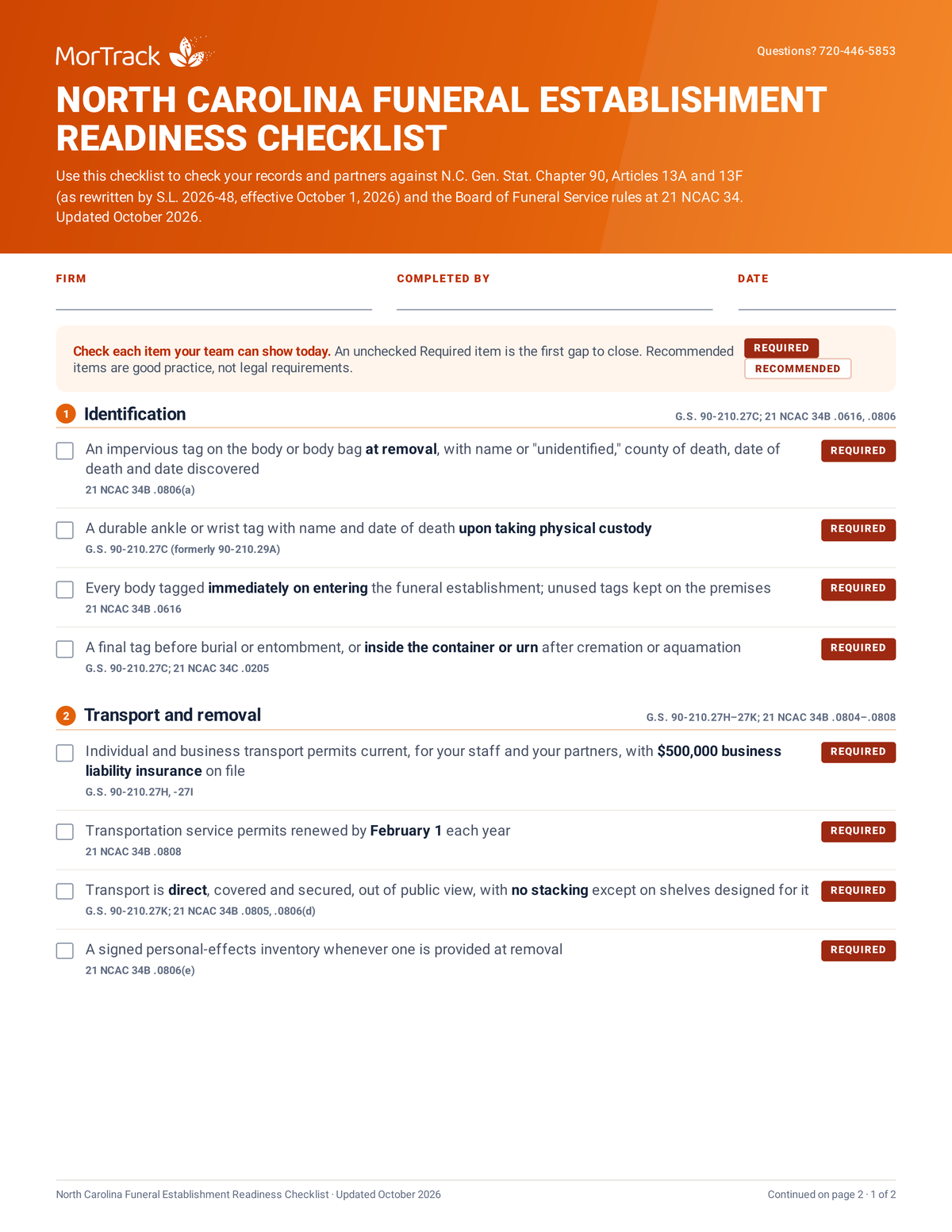
North Carolina Readiness Checklist

PDF · 2 pages

North Carolina Readiness Checklist

A quick way to see where you stand. Check what your firm has in place against North Carolina’s requirements, with legal requirements and recommended practice clearly separated.

How MorTrack helps North Carolina firms

North Carolina expects every loved one to be identified from the moment you take custody through final disposition. MorTrack gives your team one simple way to document that journey as it happens, alongside the tags and forms you already use.

MorTrack on desktop and mobile, showing a case being tracked from first custody to final disposition
  • Custody recorded the moment it happens

    Removal staff and drivers confirm custody from their phone at pickup and drop-off, even without a signal. The record starts when custody does, not hours later.

  • One record, every business

    A unique ID ties every movement, signature, form and personal effect to one case, and funeral homes, crematories, removal companies and trade services each record their part on it.

  • Know who’s in your care, and where

    A live dispatch board shows each loved one’s location, down to the room, shelf and refrigeration unit.

  • Ready for inspections and audits

    Pull body logs, cremation counts and the full custody chain for any case, whenever you need them.

MorTrack works alongside your case-management system. It helps support compliance readiness; it doesn’t replace North Carolina’s required tags and forms or guarantee compliance.

Book a 30-minute North Carolina walkthrough

See how positive ID, handoffs and release records work in MorTrack, alongside North Carolina’s requirements.

Questions? 720-446-5853

Frequently asked questions

S.L. 2026-48 renumbered the funeral service statutes, and the codified statutes on ncleg.gov may still show the old numbers. For example, the tagging requirement now at G.S. 90-210.27C was previously G.S. 90-210.29A.

S.L. 2026-48

Informational and educational only; reflects MorTrack’s reading of North Carolina law (N.C.G.S. Ch. 90, Art. 13A, as amended by S.L. 2025-76 and S.L. 2026-48; 21 NCAC 34) as of October 2026. Not legal advice. Laws, rules and enforcement change. MorTrack makes no warranty that this summary is complete or current, and use of MorTrack does not guarantee compliance with any law or regulation. Confirm requirements with the North Carolina Board of Funeral Service or qualified legal counsel.

Last verified: October 2026